
Products
The second sub tab, “Products”, contains all of the work order’s products that will be fabricated. Your work order may contain just one product, one product with several sub-assemblies, or there may be several distinct products that have been grouped together because they all will be installed into the same location, they share the same materials, they have similar installation dates, etc.
Print Label Checkbox
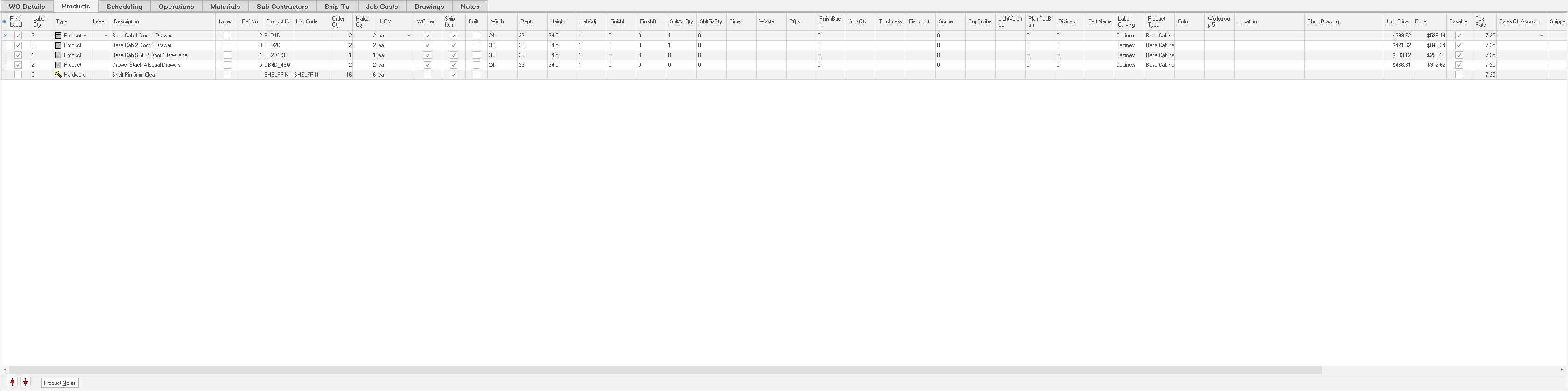
Indicates whether or not you want ShopPAK to generate a product label(s) for the product. New products default to how you’ve set your ShopPAK Options | Jobs tab’s “Print Labels” checkbox.
Label Quantity
Number of product labels to generate. Defaults to “Order Qty”, however, you can override if you need to print a different quantity.
Type
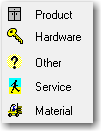
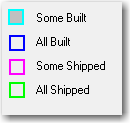
Identifies the type of product. Each type has a unique icon that is used on the job tree. To track individual product status, ShopPAK draws a colored square around the icon: Aqua - Some built, Blue - All Built, Violet - Some Shipped, and Green - All Shipped.
Level
Describes product role. ‘Blank’ means that is a normal product. ‘P’ means it is a ‘parent’ product – consisting of one or more child or sub-assembly products. ‘C’ means it is a ‘child’ product or a sub-assembly of a parent product.
Description
60 character product description.
Notes Checkbox
Indicates if the product also has a corresponding note attached to it.
Reference Number
Unique sequential number associated with the product. If you use unique reference numbers in ProjectPAK to identify products, the ProjectPAK Estimate Conversion Utility sends the unique reference numbers over to ShopPAK.
Product ID
Code that represents the product. If you use product assembly codes / IDs in ProjectPAK to identify products, the ProjectPAK Estimate Conversion Utility sends the unique codes over to ShopPAK.
Inventory Code
Read only cell. If the Product is based on a ShopPAK inventory item, the inventory code is displayed.
Order Quantity
Quantity of the product to fabricate.
Make Quantity
Automatically defaults to the ‘Order Quantity’, however, you can override when necessary if you wish to build more than the ‘Order Quantity’ and store in stock as a finished good.
UOM
Unit of measure drop down pick list. Uses the ProjectPAK user defined list of unit of measures.
Work Order Item Checkbox
Placing a check into the check box tells ShopPAK to include the product on a work order when printing product information. New products default to how you’ve set your ShopPAK Options | Jobs tab’s “Print on Work Order” checkbox.
Ship Item Checkbox
Placing a check into the check box tells ShopPAK to include the product when dragging products from a work order on to a shipping ticket (this is done on the ShopPAK Shipping tab). New products default to how you’ve set your ShopPAK Options | Jobs tab’s “Print on Packing Slip” checkbox.
Built Checkbox
Indicates if the product has been completed or not.
Percent Built
Read only. Shows the percentage of build product compared with order quantity.
ProjectPAK Custom Columns
ShopPAK shares ProjectPAK custom columns so custom product information defined in ProjectPAK flows through to ShopPAK when converting a ProjectPAK estimate into a first-cut ShopPAK job.
ProjectPAK Work Group Columns
ShopPAK shares ProjectPAK work group columns so information defined in ProjectPAK flows through to ShopPAK when converting a ProjectPAK estimate into a first-cut ShopPAK job.
Location
Installation location (building, floor, room, elevation, etc.) of the product.
Shop Drawing
Name of the shop drawing file that describes the product.
Unit Price
Product unit price.
Price
Read only field. ShopPAK calculates ‘Price’ by multiplying ‘Order Quantity’ times ‘Unit Price’. If maintaining sell price at the ‘Product Level’, changes to a product’s price ‘bubble up’ through the job tree.
Taxable Checkbox
Indicates if the product is taxable or not.
Tax Rate Percentage
Tax rate percentage to use when calculating product tax.
GL Account Code
Sales / Revenue GL Account Code to use when exporting a ‘regular’ invoice that includes the product row.
Shipped Date
Read only field that shows when the product was shipped.
Shipper Number
Read only field that identifies the Ship Ticket number that the product was shipping on.
Quantity Shipped
Read only field that identifies the quantity of the product that has been shipped.